
%20(1).png)


Most startup founders choose a design agency through a well-established checklist, reviewing their portfolio, comparing the prices, and looking at their Clutch. They'll pick around four to five agencies, where at least two will have some variation of "we work with AI startups" on their website and some decent work.
But I bet you none of them will have a satisfying answer to the main questions: have they ever designed an intuitive AI interface, and can they do it when deadlines are burning?
We at Habitat have been designing AI products for years and have seen how agencies can fail with AI design. Below you’ll find the screening framework we'd use if we were on the other side of the table.
TL;DR
The usual agency checklist (portfolio, process, pricing) was built for SaaS and e-commerce. AI founders need to ask six different questions to see if the agency is a fit:
- Have they designed AI interfaces with no existing patterns to reference?
- Can they show a verifiable fastest delivery in days, not weeks?
- Does their portfolio hold together across brand, product, and website?
- Can you reach the designer directly, or does everything route through an account manager?
- Do they deliver something that runs, or just Figma files?
- Can they show a specific screen that they designed for AI uncertainty or failure?
Miss any of these, and you'll spend time evaluating agencies that can't serve your actual case.
Why standard criteria fall short for AI
Designing for AI is about making the AI's behavior consistent across time. It should remain clear what AI did, why it did it, and what the user does next. A static mockup doesn't capture that. Neither does a portfolio full of SaaS dashboards and e-commerce checkout flows, even polished ones.
The design problems AI products face are genuinely new. When a product surfaces recommendations based on data users can't audit, for example, there's no existing convention for how to show model confidence or handle the moment when the AI's judgment diverges from the user's. Once an agent takes action on a user's behalf, the interface inherits everything a human operator would have handled, including the situations where the data is incomplete and the answer is wrong.
So here are six questions we recommend founders consider when they search for the right web design agency.
#1. Have they designed interfaces that didn't have a blueprint?
The first question to ask the agency is whether they have ever had to invent the interface patterns themselves, rather than adapt existing ones.
Most product categories have established conventions. SaaS dashboards, fintech, and healthcare portals have two decades of shipped products, so there are patterns to study and iterate on. AI products at seed and early Series A, on the other hand, often don't have that foundation, so someone has to figure it out.
Lucend was that kind of product. An AI platform for data center optimization with nothing comparable in the market, no UI patterns to reference, and no precedent for what operations managers should see on their dashboard. We designed it from first principles: what to show, what to hide, how to signal uncertainty in outputs users couldn't audit, and what the interface does when the AI is wrong.
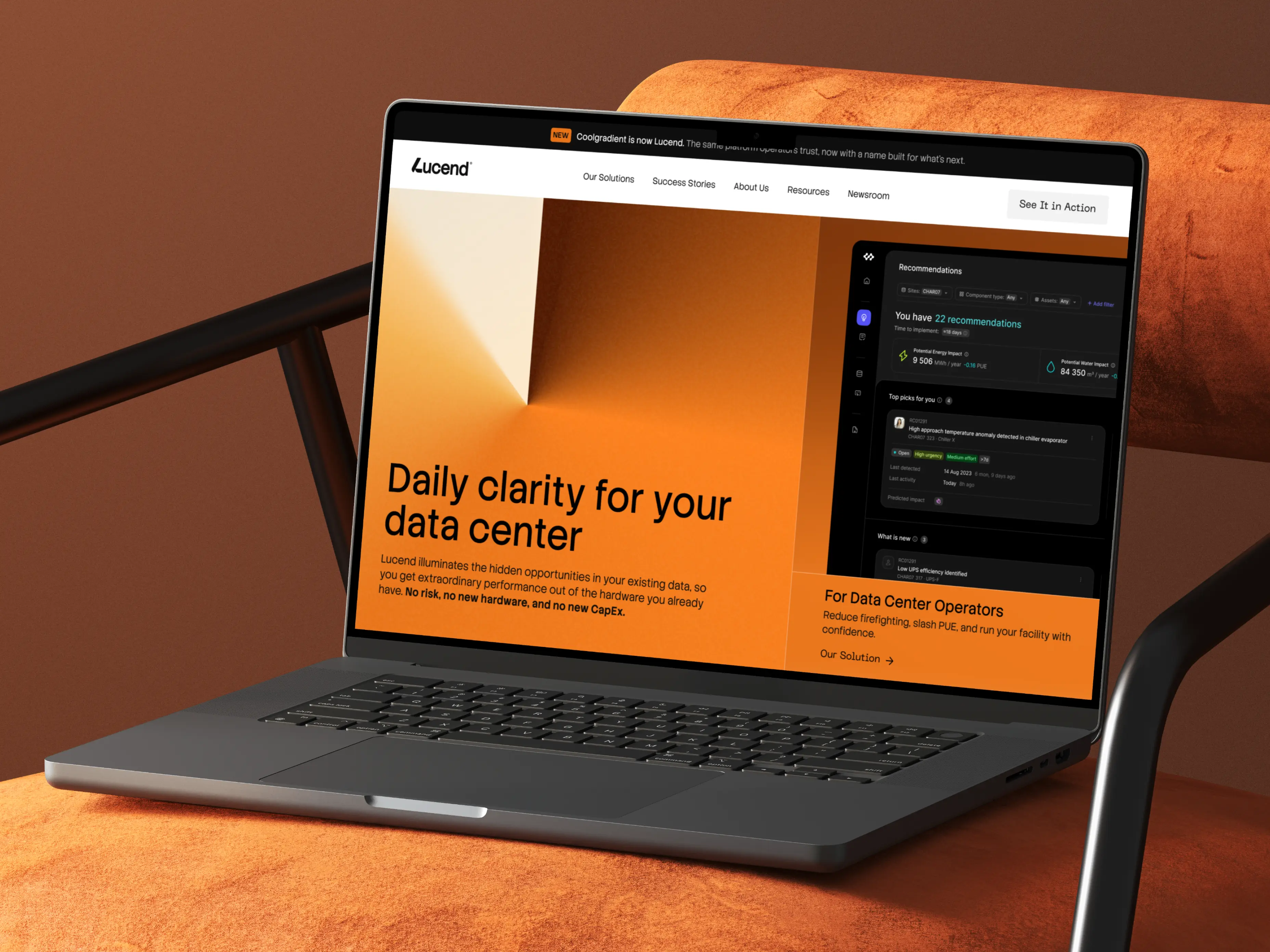
The prototype, built before the product shipped, secured Lucend's first clients. They went on to raise $3.3M, grow their client base 13x, and win Amsterdam's Hottest Startup in 2024.
That kind of experience is visible in a portfolio if you know what to look for. Ask the agency to show you a screen where they designed around the AI's limitations. A designer who's been through it will have something specific, like a before-and-after where they refined the trust layer the product depended on.
#2. How fast have they delivered?
In agency conversations, "we can adapt to your timeline" functions the same way "we're client-focused" does. It's not false, but it doesn't tell you much.
So be more specific and ask what's the fastest the agency's gone from initial brief to investor-ready materials, and what was the actual client situation.
To give you an example from Habitat’s experience, Revo went from brief to pitch deck and landing page in 12 days and closed their round 40% above target. That's not a typical outcome for any engagement, but it shows what's achievable when the process is designed for fundraising timelines from the start. For comparison, the standard agency discovery phase can run longer than that entire engagement.
Worth probing: "At your fastest, what was the client situation and what did you ship?" The onboarding benchmark worth knowing is two to three days, with the first deliverable being under two weeks. If those numbers require negotiation, the process wasn't built for your situation.
#3. Do they own the full product, or just one layer?
The standard early-stage approach to design is to fragment — a brand studio for identity, a freelance UX designer for the product screens, a web developer for the site. Each vendor costs less than a full engagement. The coordination overhead never shows up in an invoice.
But in investor presentations, the brand identity, product screenshots, and website look like three separate decisions about what this company looks like. Investors read that fragmentation as a signal about the company, whether they consciously mean to or not.
What to look for in a portfolio is coherence across the whole stack. Check if brand guidelines, product screens, and a live website have the same visual logic rather than three separate briefs. The agencies that can do this don't usually advertise it, but their work just looks like it came from one mind.
#4. Are they in your workflow, or presenting to it?
There are two structurally different ways a design agency can work with a client. In one, they take a brief, disappear for two or three weeks, and present concepts in a meeting. In the other, they're in your Slack, inside your Figma, making visible progress in real time, with the designer you can reach directly.
For an AI startup with a six-to-eight week fundraising window, the distinction matters. A single presentation-and-revision cycle typically burns three to four weeks of calendar time. Two cycles, which is standard, and the window is closed.
Check how the agency describes a discovery phase, as the start of the engagement or as getting into your product context and having something to show in days. Direct access to the designer, async-first communication, and working inside your existing tools are must-haves.
#5. Do they ship something that runs?
For a founder going into investor conversations, there's a difference between showing screens and showing something that responds. Investors who click through a working interface form a different impression than if they scrolled through static mockups. Early customers who use a real prototype give feedback that design reviews don't. Engineers who inherit a deployed design system ship consistent UI from day one rather than spending two weeks interpreting a handoff file.
That’s why at Habitat, we deliver a clickable prototype whenever possible. For Baselane, we built a full design system over four months, including foundations, components, and patterns.
.png)
When Baselane Smart launched with a full product rebrand, updating everything took four hours. Foundation tokens changed, and the rest propagated.
So, here’s the question to ask an agency: at the end of this engagement, what do you deliver?
#6. Have they designed trust into an AI product?
If I were to name the one question most agencies can't answer with a specific example, this is it.
Nielsen Norman Group's 2026 State of UX report identified trust as the defining design challenge for AI products right now. And that grows as more AI agents get deployed while users develop sharper instincts for inconsistent AI features. The trustworthy products have one thing in common: the design covers moments when the AI is uncertain, wrong, or acting on information the user can't verify.
Most design agencies have excellent instincts for building confidence in a product. They know how to make an interface feel polished, authoritative, and premium. That's not the same thing as building trust. Confidence is an aesthetic quality, while trust is built through specific decisions that sit underneath the visual layer, in the moments most agencies never get to.
In practice, those decisions cluster around a few questions:
- Does the user understand what the AI is doing and why?
- Can they disagree with the AI's recommendation?
- And when the AI is wrong, does the interface handle that gracefully, or does it go quiet?
From our experience, this is the easiest question to answer well in a conversation and the hardest to fake in a portfolio. Ask to see the real examples.
How to use these questions in a real conversation
Most design agencies are good at what they were built for, and the standard selection criteria work for the clients they were designed around.
But AI products require a partner who has solved the interface problems that are AI-specific. And fundraising windows need a process built for that constraint from the start. The agencies that can do both are a smaller subset of the market than a Google search implies, but they're findable.
Habitat is the design agency built for this. We shipped investor-ready work in 12 days, designed interfaces where no analogues existed, and built systems that let clients rebrand entire products in four hours. If that’s what you are looking for, let’s have a chat, or simply send us a link to your project, and we’ll come back with a free audit.